High-Value Visits. Zero Friction.
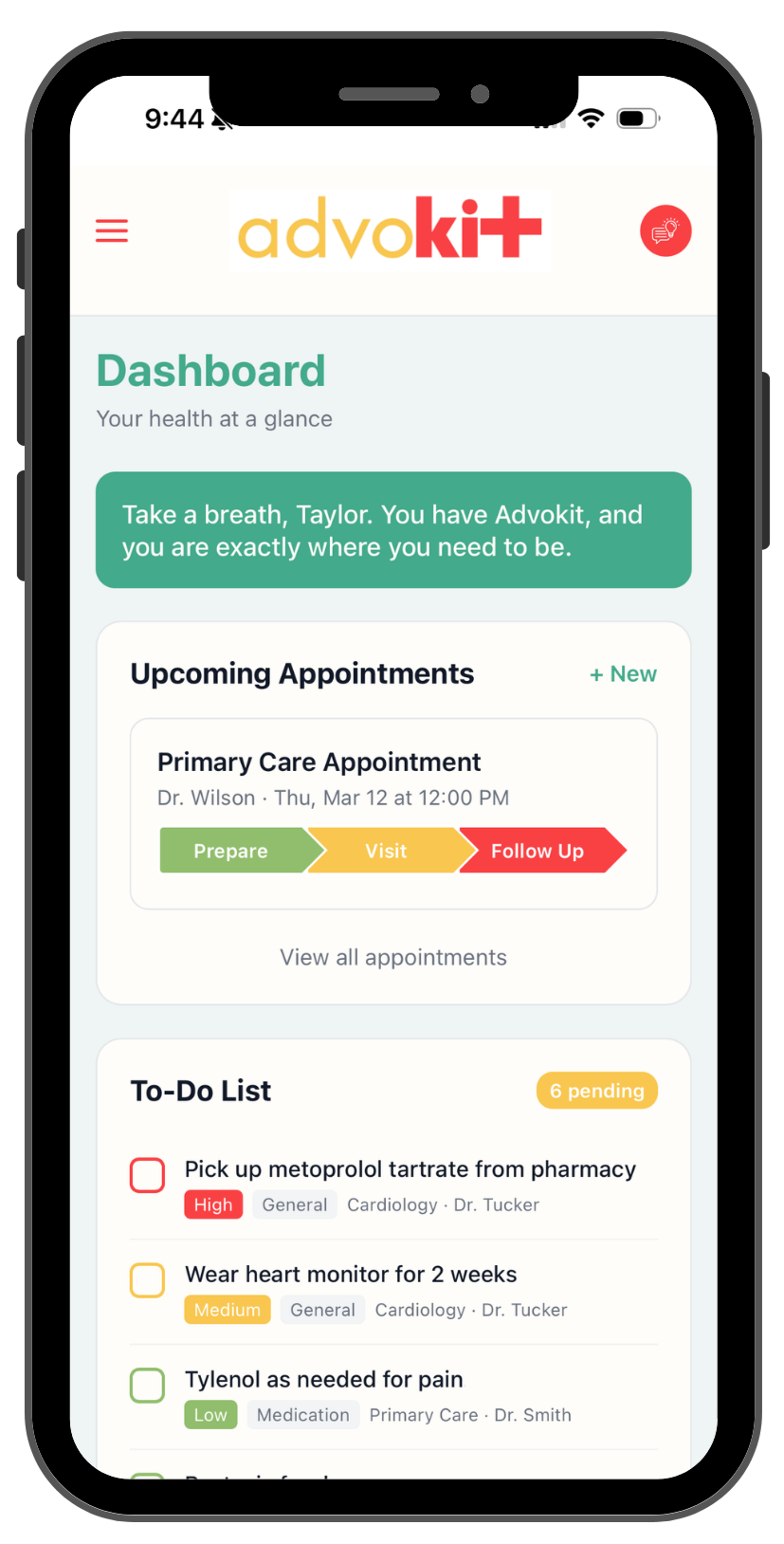
A tool designed with you in mind.
Advokit is an AI-powered appointment co-pilot. Our goal is to bridge the gap between patient needs and provider schedules, ensuring every minute of your visit counts.
How this helps your workflow today:
Focused Agendas: Your patient has a pre-set list of goals, eliminating the "one last thing" as you’re trying to leave.
Structured Histories: Key symptoms and evidence are organized so you can scan the clinical facts in seconds.
Better Adherence: We help patients capture your instructions and generate a clear action plan, reducing follow-up portal messages and confusion.
Patient Ownership: We empower patients to be prepared partners, not just passive participants.
A Collaborative Spirit: Advokit is built to foster trust. We encourage patients to record conversations (with your permission) so they can revisit your expert advice accurately, reducing confusion and follow-up calls to the office.
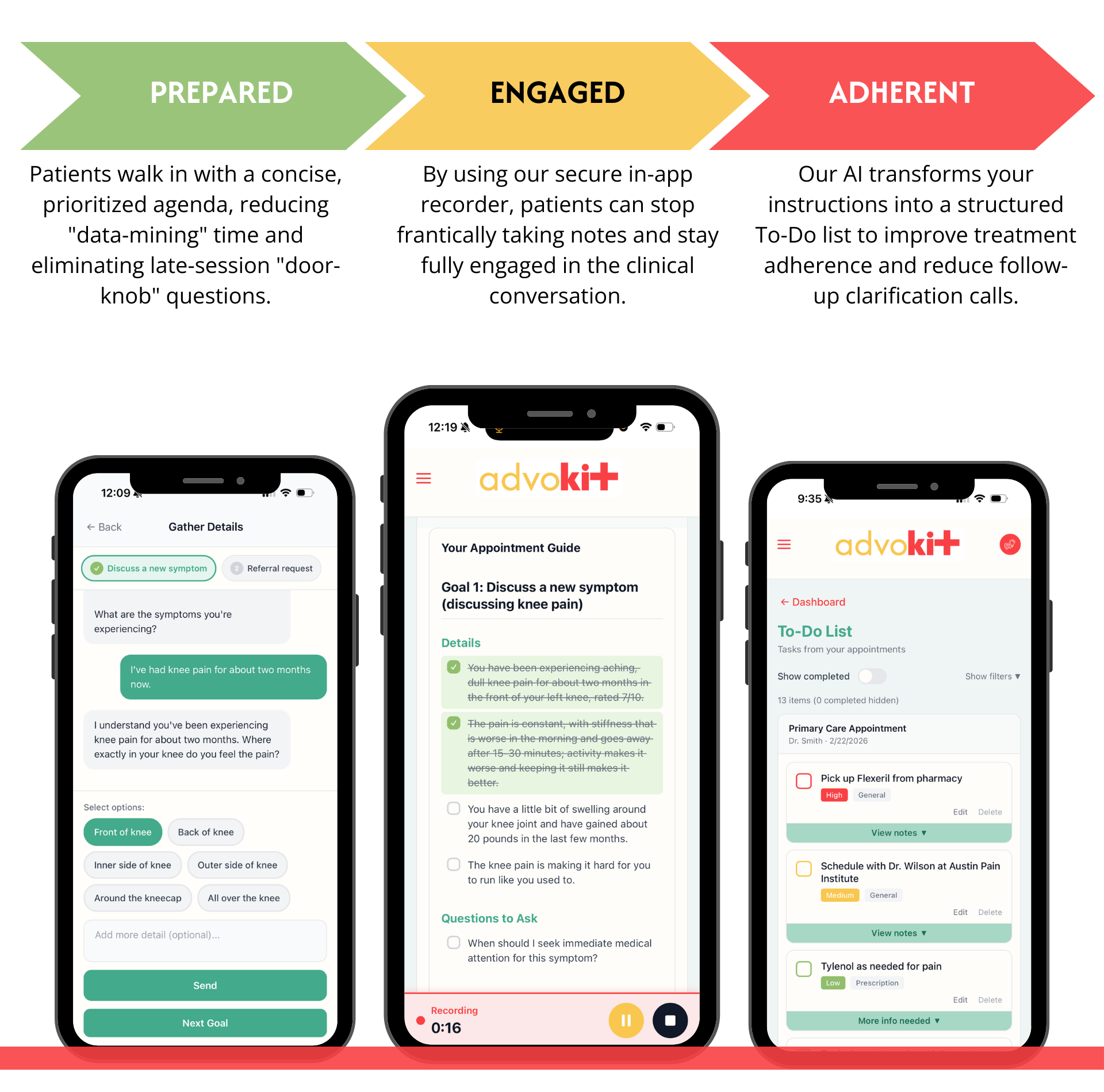
How Advokit Works
A Better Patient Partnership in 3 Steps:
FAQs
-
No. Advokit is designed to support your clinical expertise, not replace it. We know that the most precious resource in a clinic is time. Advokit serves as a pre-visit prep and post-visit follow-through tool that bridges the gap between patient concerns and your clinical guidance. We explicitly instruct users that all medical questions, diagnoses, and treatment decisions must come directly from you.
Our AI tools are trained to prompt the patient to "Ask your doctor" whenever a clinical question arises. We are here to ensure that the work you do in those 15–20 minutes has a lasting, positive impact on the patient’s health outcomes long after they leave your office.
-
In the United States, legality is governed by state-level wiretapping laws.
One-Party Consent: In 38 states (plus D.C.), it is legal for a patient to record a conversation as long as they are a participant in it.
All-Party Consent: In 12 states, all participants must consent:
California
Delaware
Florida
Illinois
Maryland
Massachusetts
Montana
Nevada
New Hampshire
Pennsylvania
Washington
(Note: These laws can be nuanced. Always check your local regulations to be sure.)
Regardless of the law, Advokit explicitly encourages patients to ask for your permission first. We believe that transparency is the best way to build a strong therapeutic alliance and ensure both parties feel comfortable.
-
Research consistently shows that patients forget a staggering amount of clinical information the moment they leave the room.
Improved Recall: Since Dr. Pieter Ley’s landmark 1979 study, we have known that patients forget up to 80% of what they hear in the exam room almost immediately. Advokit isn't changing your advice; it's simply ensuring your advice makes it home.
Adherence & Safety: Research in PLOS ONE indicates that patients who don't accurately remember instructions cannot be adherent. Recordings serve as a "safety net" to ensure they follow your exact dosage, timing, and follow-up instructions.
Reduced Administrative Burden: Patients who can revisit your instructions are less likely to call your office with "what did the doctor say?" follow-up questions, saving your staff time.
-
We take data integrity seriously.
In-App Recording: When a patient uses the Advokit built-in recorder, the audio is stored securely and used solely to generate a high-level summary and a structured To-Do list.
No Playback: Currently, our in-app recorder does not have a playback option for the audio file. This prevents the audio from being clipped, shared, or manipulated by the user. It exists purely as the "source of truth" for our AI to help the patient execute your orders.
Imported Audio: Patients do have the option to import audio recorded on other apps. In those cases, Advokit cannot control storage or playback. However, we encourage use of our internal tool to ensure the most professional and secure experience for both you and the patient.
-
Actually, many experts argue the opposite. Transparent recording provides a clear record of your thoroughness, the options you presented, and the informed consent provided by the patient. As The British Medical Journal notes, encouraging open recording can actually improve the quality of evidence-based medicine and decrease "defensive medicine" by creating a culture of mutual accountability.